


A single misstep on UAE roads could now cost you more than just money; it could cost you your freedom. Since Federal Decree-Law No. 14 of 2024 came into effect, violations such as jaywalking, driving under the influence of alcohol, and even fleeing the scene of an accident can lead you straight to court rather than simply resulting in a fine; gone are the days of minor penalties or trivial fines that fail to reflect the gravity of serious traffic offenses.
This guide details the traffic violations that carry a prison sentence, the potential fines, and how demerit points are calculated against your license. Whether you are a resident, a tourist, or a new driver, familiarizing yourself with these rules before being stopped by the authorities is the only way to ensure your safety, comply with the law, and avoid a court appearance; we therefore recommend reading this guide before setting out on your next journey.
Quick Facts:
| Detail | Information |
|---|---|
| Governing Law | Federal Decree-Law No. 14 of 2024 |
| Effective From | March 29, 2025 |
| Maximum Fine | Up to AED 200,000 (drug-related driving) |
| Maximum Jail Term | Up to 2 years (plate forgery, hit-and-run) |
| Enforcing Authorities | Dubai Police, Abu Dhabi Police, RTA, Sharjah Police |
| Licence Suspension Trigger | 24 black points within 2 years |
| Licence Cancellation Trigger | 36 black points, or 3rd major offence |
| Applies To | All 7 Emirates |
What Is the New UAE Traffic Law on Fines and Imprisonment?
The United Arab Emirates has comprehensively amended its traffic penalty system under Federal Decree-Law No. 14 of 2024, which replaced the previous 1995 legislative framework and entered into force on March 29, 2025. This law applies uniformly across all seven emirates, meaning that a violation committed in Sharjah is subject to the same rules and regulations as one committed in Dubai or Abu Dhabi. The law was designed to close loopholes that previously allowed repeat offenders to simply pay a fine, regardless of the severity of their driving behavior.
Must Explore: UAE Fine Check
Federal Decree-Law No. 14 of 2024 Explained
This Decree-Law distinguishes between violations classified as purely administrative—with penalties limited to fines and traffic points—and those classified as criminal offenses, which entail imprisonment in addition to financial fines. The law also mandates the establishment of a “Federal Traffic Council” to standardize law enforcement procedures across all emirates and to regulate the mechanisms for issuing and suspending driving licenses. Courts now operate within clearly defined sentencing ranges, thereby reducing disparities in the handling of similar cases across the different emirates.
Why the UAE Tightened Traffic Penalties
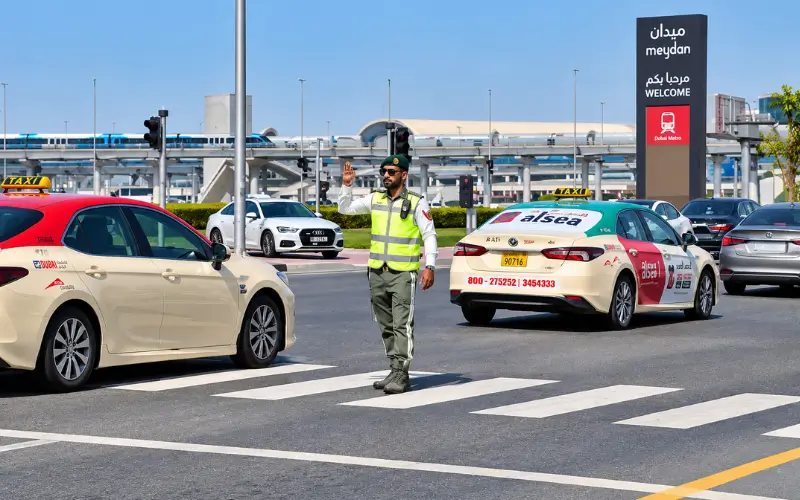
Authorities introduced this amendment in response to a rise in serious traffic incidents involving drunk driving, reckless pedestrian crossings on highways, and drivers fleeing the scene of accidents. The objective was straightforward: to impose penalties severe enough to make people think twice before taking such risks. Smart law enforcement also played a role; as AI-powered radar and camera systems became capable of detecting violations that previously went unnoticed, it became essential to implement strict penalties commensurate with this new level of detection accuracy.
Who Can Be Jailed Under UAE Traffic Law?
Imprisonment is no longer reserved solely for extreme cases; common traffic violations—if repeated or accompanied by an accident—can lead to a court appearance rather than a simple fine. This applies equally to citizens, residents, tourists, and delivery drivers; there is no preferential treatment based on nationality or visa status.
Offences That Always Carry Jail Time
Offenses such as driving under the influence of drugs, hit-and-run incidents, vehicle license plate forgery, and causing death through reckless or negligent driving are classified as criminal offenses; this necessitates judicial proceedings, regardless of the driver’s background or nationality. Such cases are referred to the Public Prosecution system rather than being resolved merely through the payment of a standard traffic fine.
Offences Where Fine or Jail Applies
In cases of violations—such as illegal pedestrian crossings resulting in an accident, driving with a suspended license, or driving under the influence of alcohol without causing injuries—the court has the discretion to impose a fine, a prison sentence, or both. The final ruling depends on the severity of the violation, the offender’s prior record, and whether the incident resulted in injuries. Typically, penalties are limited to a fine for a first offense that caused no injuries, whereas repeat offenses or those involving aggravating circumstances tend to result in actual prison sentences.
| Offence | Fine (AED) | Jail Term |
|---|---|---|
| Jaywalking causing accident (road ≥80km/h) | 10,000+ | Minimum 3 months |
| Drunk driving | 20,000 – 100,000 | Court discretion |
| Drug or psychotropic-substance driving | 30,000 – 200,000 | Court discretion |
| Fleeing accident scene / non-cooperation | 10,000 – 100,000 | Court discretion |
| Forged or misused licence plates | 20,000+ | Up to 2 years |
| Driving on a suspended licence | Up to 10,000 | Up to 3 months |
| Causing death by negligent driving | Minimum 50,000 | Jail term applies |
| Death under severe circumstances (DUI/flood) | Minimum 100,000 | Minimum 1 year |
How Much Are UAE Traffic Fines for Common Violations?
Not every traffic violation necessarily results in a court appearance; most everyday infractions are still handled through the imposition of fines and the assignment of demerit points. Below is an overview of the most common violations among average drivers and how fine amounts vary based on the severity of the offense.
Speeding Fines by Limit
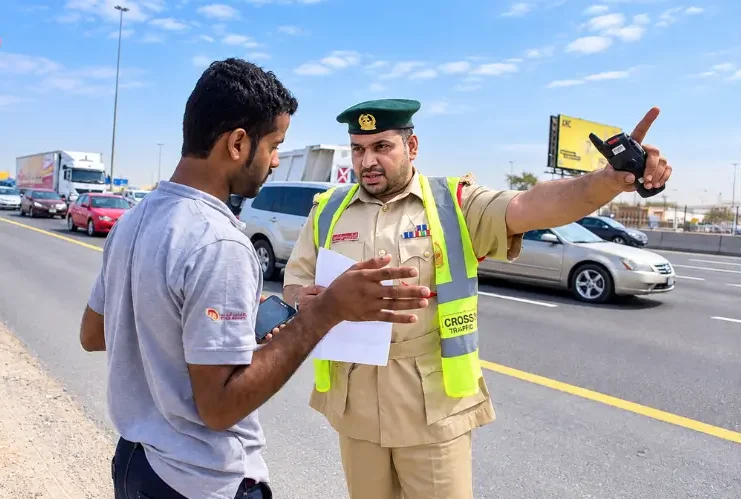
Speeding fines vary depending on the extent to which the speed limit is exceeded; a minor violation may cost a few hundred dirhams, whereas exceeding the limit by 60 km/h is considered a serious offense that warrants vehicle impoundment. Radar systems on major roads—such as Sheikh Zayed Road and Al Khail Road—operate based on the specific speed limit posted at any given moment; therefore, it is always advisable to check overhead traffic signs rather than relying on memory.
Mobile Phone, Seatbelt and Child Seat Fines
Violations such as using a mobile phone while driving, failing to wear a seatbelt, or seating a child under the age of 10 (or shorter than 145 cm) in the front seat are among the most common infractions; they are frequently detected by AI-powered radar systems rather than by field traffic patrols. These systems are capable of identifying a phone held in hand, an unfastened seatbelt, or improper child seating—even amidst fast-moving traffic—which explains the high volume of such violations recorded annually.
Reckless and Dangerous Driving Fines
Reckless or dangerous driving—including tailgating, sudden lane changes, and generally aggressive driving—incurs the highest number of demerit points, with the exception of the previously mentioned criminal offenses. Furthermore, repeated fines for reckless driving within a short period may lead to a review of the driver’s license, even if no single incident was severe enough to warrant its suspension.
Parking and Documentation Fines
Violations such as parking in a restricted area, allowing vehicle registration to expire, or driving with excessively tinted windows may seem minor, yet they carry fines ranging from AED 200 to AED 1,500, in addition to the potential for the vehicle to be impounded or briefly seized. These are among the easiest violations to avoid; they rarely require split-second decision-making, as a quick check of the registration status or parking location before setting off is usually all that is needed.
| Violation | Fine (AED) | Black Points |
|---|---|---|
| Speeding 1–20 km/h over limit | 300 – 400 | 2 – 4 |
| Speeding 21–40 km/h over the limit | 500 – 700 | 4 – 6 |
| Speeding 41–60 km/h over the limit | 1,000 | 12 |
| Speeding 60+ km/h over the limit | 3,000 | 23 |
| Using a mobile phone while driving | 800 | 4 |
| Not wearing a seatbelt | 400 | 4 |
| Running a red light | 1,000 | 12 |
| Reckless driving | 2,000 | 23 |
| Tailgating | 400 | 4 |
| Child under 10 in front seat | 400 | 4 |
When Does a Traffic Fine Turn Into a Criminal Case?
A fine escalates into a criminal case once the violation causes actual harm, is repeated, or involves an attempt by the driver to evade accountability. Understanding these criteria helps you distinguish the fine line between a mere procedural nuisance and a legal case.
Repeat Offences
A fine ranging from AED 2,000 to AED 10,000 is imposed for driving with an unrecognized foreign license for the first time; however, a repeat offense increases the penalty to AED 50,000 and entails imprisonment for a minimum of three months. This escalating penalty structure is a general feature of the law, as a first offense is treated far more leniently than a second or third one.
Accidents That Cause Injury or Death
Reckless driving resulting in death carries a fine of no less than AED 50,000, in addition to a prison sentence. If the accident occurs under aggravating circumstances—such as driving under the influence of alcohol or driving on flooded roads—the minimum prison sentence increases to one year. Courts also take into account whether the driver disregarded basic safety measures, such as adhering to speed limits and lane discipline, prior to the accident.
Hit-and-Run and Fleeing the Scene
Leaving the scene of an accident or providing false information to a police officer is treated with the utmost seriousness, as penalties can include a fine of AED 100,000 and imprisonment; such actions hinder the determination of the actual circumstances of the incident. Therefore, even minor collisions must be reported immediately at the scene, as leaving—regardless of how slight the damage may be—can transform a minor accident into a criminal case.
How Are Black Points Linked to Licence Suspension?
Demerit points are recorded against your driver’s licence rather than the vehicle; consequently, they remain associated with you even if you change your car or rent another one. Each violation carries a specific, fixed number of points, and these points accumulate over a continuous two-year period, rather than being reset at the start of each calendar year.
| Black Points Reached | Consequence |
|---|---|
| 8 – 23 points | Warning stage; awareness course removes up to 8 points |
| 24 points (within 2 years) | Licence suspended for a minimum of 3 months |
| 36 points | Licence fully cancelled; re-test required |
Completing the “black points” awareness course—offered by the Traffic Authority—is the only official method to reduce your point balance before reaching the threshold for license suspension; therefore, it is advisable to book a session as soon as your point balance begins to rise, rather than waiting until you receive a license suspension notice.
How Do Traffic Penalties Compare Across the Emirates?
Federal law establishes the primary penalties; however, day-to-day enforcement methods and reporting channels vary slightly depending on the emirate where you drive.
Dubai
Dubai Police handles serious traffic violations—such as speeding, driving under the influence of alcohol, and running red lights—while the Roads and Transport Authority (RTA) manages matters related to vehicle parking, vehicle registration, and “Salik” toll system fines. Both entities share a unified federal database for “black traffic points,” enabling each to instantly view any violation recorded by the other.
Abu Dhabi and Sharjah
While Abu Dhabi Police and Sharjah Police issue and track traffic violations through their respective smart applications, the fine amounts, traffic penalty points, and custodial sentences for violations governed by federal legislation remain identical to those applied in Dubai, as Federal Decree-Law No. 14 of 2024 applies equally across all seven emirates. Differences at the local level lie in the frequency of law enforcement campaigns and the designation of specific road sections for additional radar coverage during certain periods.
What Should You Do If You’re Fined or Facing a Court Case?
The way you respond in the first few days following a serious violation can significantly affect the outcome.
If You Receive a Fine
Check the violation via the Dubai Police app, the Roads and Transport Authority (RTA) website, or the police portal of the relevant emirate, then proceed to pay the fine or submit an appeal within the specified timeframe; failure to pay fines may result in restrictions preventing the renewal of your vehicle registration and license.
If You’re Facing a Criminal Charge
Regarding any violation that could result in a prison sentence, it is advisable to consult a lawyer licensed in the UAE at an early stage; the outcome of the proceedings often hinges on documentation, witness testimony, and the promptness of your cooperation with the investigation.
How Much Does It Cost to Release an Impounded Vehicle?
In addition to fines and imprisonment, many serious violations entail the impoundment of the vehicle, and the process of retrieving the car imposes an additional financial burden that drivers often overlook.
Impoundment Periods by Offence
Typically, the duration of a standard vehicle impoundment—linked to violations such as speeding or expired registration—ranges from 7 to 30 days, whereas other violations—such as reckless driving, racing, or repeat offenses—may result in the vehicle being impounded for 60 days or more. The impoundment period is determined independently of any judicial proceedings; consequently, a driver may be released on bail while the vehicle remains held in a police impoundment lot.
Release Fees You Should Budget For
Vehicle release fees vary depending on the emirate and the duration of impoundment; however, in cases of serious violations, the total cost—combining the base release fee with storage charges—can reach up to AED 100,000. Therefore, it is always advisable to verify the exact amount directly with the authority responsible for the impoundment, rather than assuming a standard, uniform rate applies.
How Can You Avoid Fines and Imprisonment in the UAE?
Most of these penalties can be avoided by adopting certain consistent driving habits:
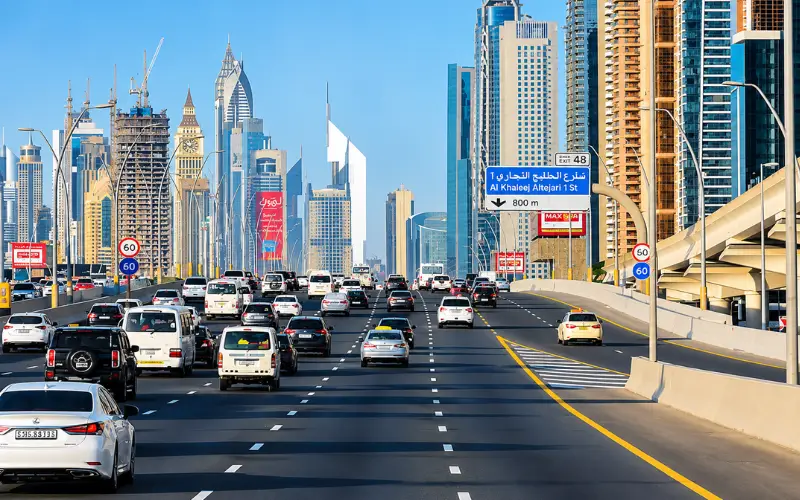
- Always check the posted speed limits, as they often change along the same road.
- Keep your phone out of reach and use only hands-free systems.
- Never drive after consuming alcohol, even in small amounts; the threshold for fines or imprisonment is low.
- Stop and report any accident, no matter how minor it may seem.
- Renew your driver’s license and vehicle registration before they expire.
- Ensure that all passengers—including children in the back seat—wear their seatbelts at all times.
Final Thoughts
The UAE’s updated traffic law was not designed to penalize ordinary drivers; rather, it aims to curb a specific set of behaviors that actually cause fatal road accidents: driving under the influence of alcohol, fleeing the scene of an accident, and reckless speeding. If you adhere to basic traffic rules, fasten your seatbelt, refrain from using your phone while driving, and avoid driving under the influence of intoxicants, you will—in all likelihood—face nothing more than a routine fine and the accumulation of a few black traffic points.
However, once a violation causes damage, is repeated, or involves evading responsibility, the law imposes actual penalties—including imprisonment and fines of up to AED 200,000. Therefore, the safest approach is simple: treat every traffic rule as if a camera is already watching you, because that is the reality on UAE roads today. Adhere to and respect the rules, and the UAE will remain one of the safest and easiest places in the world to drive.
Must Explore: How to Check Overstay Fine in UAE
Frequently Asked Questions
Can tourists be jailed for UAE traffic violations?
Yes, the law applies to everyone on UAE roads regardless of residency or nationality.
What is the maximum fine under the new UAE traffic law?
Up to AED 200,000 for driving under the influence of narcotics or psychotropic substances.
Does jaywalking really carry a jail sentence?
Yes, if it happens on a road with a speed limit of 80 km/h or more and causes an accident.
How many black points lead to licence suspension?
Reaching 24 black points within two years suspends your licence for at least three months.
Is drunk driving always punished with jail time?
Courts can impose a fine, imprisonment, or both, depending on severity and prior record.
What happens if I drive with a suspended licence?
You can face up to three months in jail and a fine of up to AED 10,000.
Can a first-time offender go to jail for a traffic offence?
Yes, offences like hit-and-run or plate forgery carry jail time even for first-time offenders.
Do black points apply to my licence or my car?
Black points are recorded against your driving licence, not the vehicle you drive.
What is the penalty for fleeing an accident scene?
Fines range from AED 10,000 to 100,000, along with possible imprisonment.
How can I check if I have any UAE traffic fines?
You can check through the Dubai Police app, the RTA website, or your local emirate’s police portal.
